 English
 Arabic

Fetal Bovine Serum vs. Horse Serum in Biomedical Research
Most labs default to fetal bovine serum because that is what the previous researcher used. No validation, no comparison, just inertia. Equitech-Bio has seen what that habit costs: failed differentiation runs, irreproducible assays, and months of data that cannot be trusted. Serum choice directly affects cell growth, differentiation outcomes, assay consistency, and reproducibility. This comparison covers fetal bovine serum versus horse serum: what each contains, where each works, and how to choose based on evidence.
What Is Fetal Bovine Serum?
Fetal bovine serum (FBS) is collected from bovine fetuses and is the most widely used supplement in mammalian cell culture. Low IgG content (typically below 10 µg/mL) and high growth factor concentrations make it broadly compatible with most cell types.
FBS Definition
FBS is sterile, filtered fetal bovine serum. Because fetal animals lack a mature immune system, antibody levels are low, reducing interference in most assay systems.
Key Components
Albumin constitutes 60-70% of total serum protein and carries fatty acids, hormones, and small molecules. Researchers running defined-media applications can source albumin bovine serum separately rather than relying on the undefined fraction in whole serum. FBS also contains IGF-1, FGF, transferrin, and attachment factors, including fibronectin.
Common Applications
HeLa, CHO, HEK293, primary cells, hybridoma production, viral propagation. If the literature does not specify otherwise, FBS is the starting point.
Lot Variability
FBS is a biological product, and biological products vary. Growth factor concentrations and contaminant profiles shift between lots. Research published in Biologicals (Wessman and Levings, 1999) confirmed FBS lot variability as a direct contributor to experimental irreproducibility. Lot reservation and side-by-side qualification are non-negotiable for any longitudinal study.
What Is Horse Serum?
Horse serum is collected from adult horses. It is not a general-purpose FBS substitute. Normal horse serum is useful in specific protocols where lower mitogenic activity is the requirement, not a limitation.
Horse Serum Definition
Adult-derived, with IgG typically in the 6-12 mg/mL range and higher total protein than FBS. Complement activity is present and can be inactivated at 56°C for 30 minutes when needed.
Key Components
Higher IgG, elevated complement proteins, and lower growth factor concentrations. That growth factor profile is what makes horse serum useful in differentiation systems.
Common Applications
Myogenic differentiation protocols, select neuronal culture systems, and immunological assays require a defined blocking or diluent serum.
Performance Profile
Cell lines that depend on high IGF-1 or FGF signaling will underperform in horse serum. That is by design.
Bovine Serum vs. Horse Serum: Core Differences
These are not interchangeable options at different price points. They are functionally different tools.
| Parameter | Fetal Bovine Serum | Horse Serum |
| Source animal | Bovine fetus | Adult horse |
| IgG content | Very low (<10 µg/mL) | High (6-12 mg/mL) |
| Growth factor activity | High | Low to moderate |
| Primary use case | General cell culture | Differentiation protocols |
| Availability | Wide | Specialty sourcing |
Source Animal
Fetal origin is characterized by low levels of immune proteins and high mitogenic activity. Adult origin means the reverse. Species matters less than the developmental stage.
Growth Factor Profile
FBS drives proliferation. Horse serum reduces it. That distinction determines most downstream decisions.
Protein and IgG
High IgG in horse serum creates a background in antibody-based assays. Researchers working across species should also note that human serum albumins carry a different glycosylation and binding profile than bovine or equine albumin, which becomes relevant in cross-species modeling.
Cell Compatibility, Availability, and Ethics
FBS supports the broadest cell range and is produced at a global scale. Horse serum requires specialist sourcing with longer lead times. In terms of sourcing ethics, FBS collection involves a terminal fetal blood draw, which is driving the adoption of defined alternatives in some research areas. Horse serum from living animals is considered less ethically contentious, though supplier standards vary.
How Serum Choice Affects Cell Culture Performance
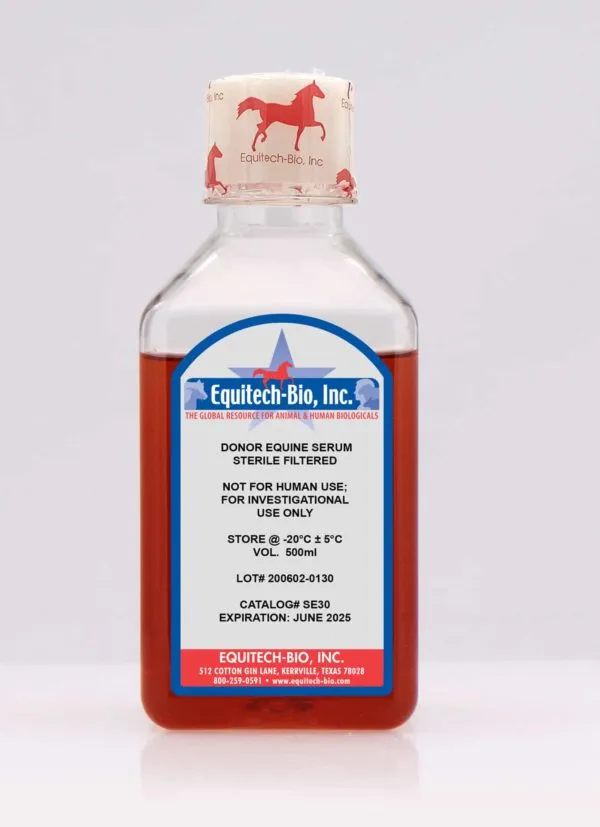
Serum type shapes every measurable outcome: growth kinetics, differentiation fidelity, assay background, and reproducibility.
Cell Growth and Differentiation Response
FBS produces faster proliferation across most mammalian cell lines. Horse serum produces slower, controlled growth suited to differentiation endpoints. The C2C12 myoblast model illustrates this distinction clearly: switching from 10% FBS to 2% horse serum at confluence withdraws mitogenic signals and triggers myotube formation. This protocol has been replicated across hundreds of published studies.
Assay Interference
High IgG in horse serum elevates the background in ELISAs and flow cytometry. Secondary detection antibodies amplify that background. If your workflow uses goat anti-rabbit IgG H&L or similar reagents, the serum in your system directly affects the signal-to-noise ratio. For species-specific blocking in multi-species secondary antibody panels, donkey serum reliably reduces cross-reactivity.
Reproducibility Impact
In FBS, lot-to-lot growth factor shifts alter proliferation and gene expression. In horse serum, IgG variation affects assay background. Both demand a lot of qualifications. That is not optional.
When to Use Fetal Bovine Serum
FBS is the right choice for broad mammalian cell culture, especially when your protocol is already validated around it. Switching serum types without revalidation introduces an uncontrolled variable, invalidating comparisons with prior data. Primary cells require attachment factors and growth signals from FBS. Established lines were characterized using it. Protocol continuity is a legitimate scientific reason to stay.
When to Use Horse Serum
Horse serum belongs in differentiation protocols and protocol-specific systems where reduced mitogenic signaling is required. Use it because your protocol calls for it and you have validated that it works for your endpoint, not because someone in a loosely related paper used it. Always run side-by-side testing before committing.
Quality Factors to Compare Before Buying Serum
Species selection is step one. Documentation determines whether a lot will actually perform.
- Origin and traceability: Confirm country-of-origin documentation. US-origin serum is collected under USDA-regulated conditions.
- Sterility and viral testing: USP-compliant sterility, mycoplasma screening, and BVDV testing for FBS lots.
- Endotoxin levels: Standard cell culture FBS is held below 10 EU/mL. High endotoxin levels activate inflammatory signaling and confound phenotypic assays.
- Hemoglobin levels: Elevated hemoglobin levels indicate poor collection practices and interfere with absorbance-based measurements.
- Certificate of analysis: Must cover sterility, mycoplasma, endotoxin, hemoglobin, total protein, and growth promotion. No COA, no purchase.
- Reserve samples: Archive a portion of every qualified lot. Mid-study anomalies need to be traced back to the source material.
How to Test a New Serum Lot
Run the qualification before you commit, not after the results look odd.
- Acceptance criteria: Define pass/fail thresholds before testing. Doubling time within 10-15% of your reference lot and consistent morphology are standard benchmarks.
- Side-by-side testing: Run candidate and reference lots in parallel, same passage cells, same day.
- Growth assessment: Track counts at 24, 48, and 72 hours. A lag of more than 15% in doubling time warrants rejection.
- Morphology checks: Photograph cells at each time point. Rounding, granularity, or vacuolation can flag cytotoxicity before it appears in growth curves.
- Functional readouts: For differentiation systems, run your endpoint assay. Passing growth criteria but failing functional criteria is still a failure.
Storage, Handling, and Documentation
- Frozen storage: -20°C minimum; -80°C for long-term preservation.
- Controlled thawing: Overnight at 4°C or 37°C water bath with regular mixing. Do not exceed 37°C.
- Aliquoting: Single-use volumes immediately after thawing. Repeated freeze-thaw cycles degrade growth factors and raise contamination risk.
- Heat inactivation: 56°C for 30 minutes inactivates complement. Not routine practice; use only when complement interference is confirmed in your specific assay.
- Lot documentation: Log lot number, COA reference, thaw date, and experiment assignment for every aliquot used.
Alternatives to Animal Serum
Serum alternatives are maturing but are not yet universal drop-in replacements.
- Serum-free media: Eliminates lot-to-lot variability but requires full protocol revalidation for each cell type.
- Defined supplements: ITS formulations replace specific serum functions in well-characterized systems.
- Recombinant proteins and species-specific albumins: Relevant for defined-media work and species-appropriate in vitro modeling.
- Human platelet lysate: An established FBS alternative for mesenchymal stem cell culture in clinical contexts, removing xenogeneic material from the system.
- Transition planning: Not a drop-in change. Revalidate every functional endpoint before trusting the data.
How to Choose Between FBS and Horse Serum
Match the application first. Proliferation and broad compatibility point to FBS. Differentiation endpoints using established protocols indicate horse serum. Qualify the lot. Confirm documentation. Equitech-Bio supplies both with full traceability, lot reservation, and complete COA documentation for research and regulated applications. A qualified lot with full documentation beats an unqualified lot of anything, every time.
Frequently Asked Questions
Here are some questions answered regarding the comparison between Fetal Bovine Serum and Horse Serum.
Can horse serum replace fetal bovine serum?
Horse serum is not a general-purpose FBS replacement. It works in specific systems where lower mitogenic activity is required, most notably during myogenic differentiation. Substituting it into a general culture protocol without validation changes cell behavior and compromises comparability with prior data.
What is horse serum used for in cell culture?
Horse serum is primarily used in differentiation protocols in which reducing proliferative signaling is part of the experimental design. The best-replicated example is C2C12 myoblast differentiation, where switching to 2% horse serum at confluence triggers myotube formation. It also serves as a neuronal culture system and for immunological blocking applications.
Why does serum lot testing matter?
A lot of variability in serum is a documented contributor to experimental irreproducibility. Growth factor concentrations, hormone levels, and contaminant profiles shift between lots within the same product category. Testing every new lot against a validated reference before committing to a study is standard, not optional.
When should serum-free media be considered?
Serum-free media is worth considering when lot variability is driving reproducibility problems, when defined inputs are required for regulatory compliance, or when validated serum-free formulations are available for your cell type. Full protocol revalidation is required. It is not a drop-in substitute, but for regulated workflows, the investment is justified.
 English
 Arabic