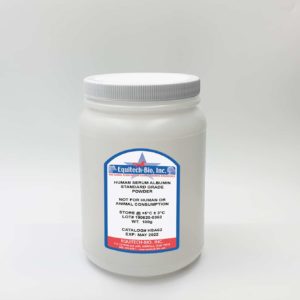
Every human albumin isn’t the same, and the gap between “human-derived” and “research-ready” is wider than most product listings let on.
Human Serum Albumin is the most abundant protein in human plasma. It’s not a background player. It’s the system. It transports fatty acids, including arachidonic acid, regulates oncotic pressure, shuttles drugs and hormones, and maintains the circulatory environment.
When you’re working with cell culture media designed to approximate human physiology, what you put in determines what you get out.
Human Serum Albumin complexed with fatty acid binding partners behaves differently from stripped or denatured preparations. That distinction matters enormously in pharmacokinetic modeling, drug development, and any cell culture application where you’re trying to do more than just keep cells alive.
Equitech-Bio’s Human Serum Albumin is prepared from human origin under strict quality controls. Consistent purity, documented lot data, and US-sourced materials.
If your research demands the most abundant protein in human plasma, it deserves a supplier who treats it that way.
Human Albumin is the dominant protein in human blood plasma, accounting for roughly half of total plasma protein content. It’s a single polypeptide with well-characterized fatty acid binding sites and a documented structural profile under multiple UniProt accessions. It’s not a generic protein reagent. It’s the central logistics protein of human circulation, and your research should treat it accordingly.
It’s the body’s primary transport system for fatty acids, including arachidonic acid, alongside hormones, drugs, and metabolites. It maintains colloidal osmotic pressure, buffers pH, and serves as the plasma’s main binding reservoir. Human serum albumin complexed with specific ligands behaves differently from free albumin, which is exactly why fatty acid binding studies require a preparation that hasn’t been stripped or compromised during processing.
Cell culture media supplementation, pharmacokinetic assay development, drug-protein binding studies, and as a reference protein in diagnostic validation. Labs using bovine IgG or chicken IgY polyclonal antibody panels alongside human albumin controls understand why species-matched reagents matter at every layer of the assay. Human albumin gives you the most physiologically relevant baseline available for human-model research.
Our Human Serum Albumin is supplied strictly for research use and cell culture applications, not for clinical administration or therapeutic treatment. It’s not labeled or tested for in vivo human use. If your question is whether it’s safe for the bench, the answer is yes: when handled under standard laboratory protocols, it’s a well-characterized, stable protein.
 English
 Arabic

 English
 Arabic