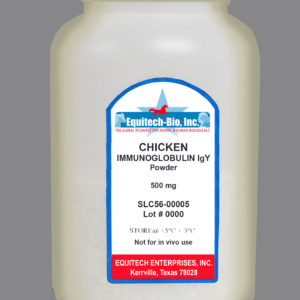
Immunoglobulin Y is the avian equivalent of immunoglobulin G in mammals, but the structural and functional differences between chicken IgY and mammalian IgG are significant enough that treating them as interchangeable in assay design is a technical error, not a shortcut.
The IgY molecule is larger than mammalian IgG, with a distinct heavy chain and light chain architecture and a molar mass that affects how it behaves under standard immunoassay conditions.
Chicken immunoglobulins accumulate in high concentrations in chicken egg yolk, which is where egg yolk-derived IgY antibodies are isolated. This non-terminal collection method yields polyclonal antibodies without repeated bleeds, making avian IgY a practical alternative to mammalian-derived primary antibody preparations in protocols where mammalian IgG cross-reactivity with anti-chicken IgY detection reagents would compromise results.
Mouse IgG and chicken IgY occupy different structural classes entirely. Goat anti-chicken IgY reagents do not cross-react with mouse IgG or other mammalian immunoglobulins, which is precisely why chicken IgG, more accurately designated chicken IgY, is useful in multiplex systems running alongside mammalian primaries. In western blot applications, IgY antibodies resolve at a distinct molecular weight from mammalian IgG, providing clean band separation.
For downstream detection, rabbit IgG antibody reference standards complement chicken IgY in cross-species calibration panels. Research use only.
 English
 Arabic

 English
 Arabic