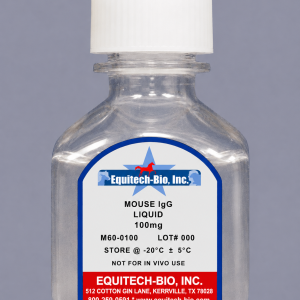
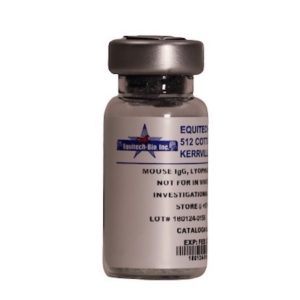
Normal mouse IgG is isolated from pooled normal mouse serum collected from non-immunized animals, giving you a polyclonal normal mouse immunoglobulin preparation that reflects the natural IgG distribution of the murine immune system rather than a single-clone snapshot.
In flow cytometry and western blotting applications, normal mouse IgG functions as an isotype control matched to the host species and immunoglobulin class of your primary antibody.
Run at the same concentration as your test antibody, it establishes the baseline non-specific signal your detection system produces independently of target binding. That baseline is what makes your positive signal interpretable rather than assumed. IgG antibodies used as isotype controls must match not just species but also subclass, since the IgG molecule structure varies across IgG1 through IgG3 subclasses in mice, and those structural differences affect Fc-receptor binding and flow cytometry scatter profiles.
Bovine IgG serves as a parallel isotype control in bovine primary systems. For maximum recovery of normal mouse IgG from the vial, briefly centrifuge the product before opening to collect any material from the cap or walls. Molecular weight is consistent with that of murine IgG across lots. A modal dialog confirmation appears during online ordering for custom concentration requests.
For human-target detection workflows running alongside murine controls, goat anti-human IgC polyclonal antibody provides species-matched secondary coverage without cross-reactivity with normal mouse immunoglobulins. Research use only.
 English
 Arabic

 English
 Arabic