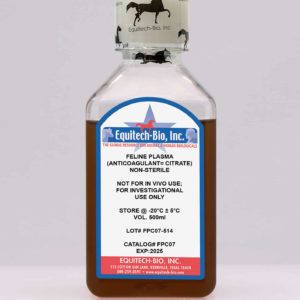
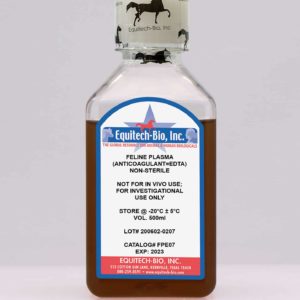
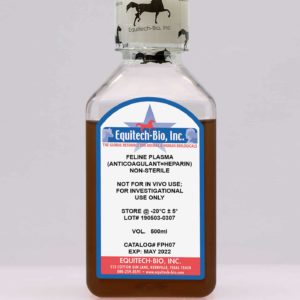
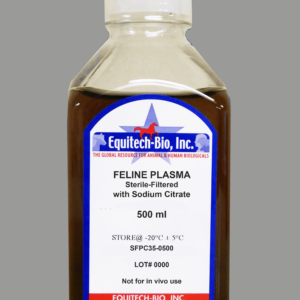
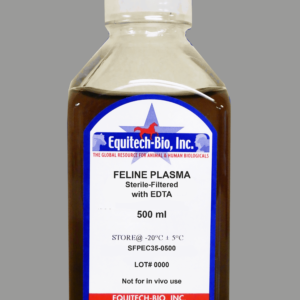
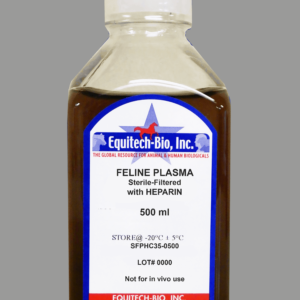
Feline plasma is the acellular fluid fraction of feline whole blood, separated from red blood cells and platelets after anticoagulant collection and centrifugation. It carries albumin, immunoglobulins, coagulation factors, and transport proteins specific to feline physiology, a biochemical profile that bovine or canine preparations don’t replicate.
The form matters. Fresh frozen plasma preserves labile clotting factors that degrade rapidly after collection. Once thawed, thawed plasma has a narrowed functional window, which is why frozen plasma storage and handling conditions aren’t procedural footnotes in feline research. They’re quality variables that determine what your material can still do upon reaching the assay.
In veterinary medicine research, feline plasma supports blood transfusion modeling, the development of plasma transfusion protocols, and studies involving liver disease, blood pressure regulation, and coagulation biology in cat models. Bovine plasma covers parallel applications in other species, but feline work requires feline-origin material. Equitech-Bio supplies feline plasma processed from controlled collections to preserve protein integrity from source to vial.
Feline plasma is the protein-rich, cell-free component of feline whole blood, retained after centrifugation, which separates red blood cells and white blood cells from the fluid fraction. It contains albumin, immunoglobulins, and active coagulation factors. Unlike serum, it preserves clotting factors and the complete native protein environment of feline circulation.
Feline plasma supports veterinary medicine research involving blood transfusion protocols, plasma transfusion modeling, and coagulation studies. It's used in clinical trials evaluating liver disease progression, blood pressure response, and body weight outcomes in feline models. Labs building species-matched reagent panels pair it with canine albumin and human albumin serum for cross-species comparison work.
Feline plasma is collected before clotting and retains coagulation factors, fibrinogen, and other clotting factors. Serum is the fluid that remains after clotting consumes those proteins. Frozen plasma is the appropriate material for blood transfusion research, platelet transfusion, or any protocol that requires functional coagulation factors. Serum is not an equivalent substitute.
Feline plasma supplied by Equitech-Bio is processed for research use. Blood typing compatibility and transfusion reactions are critical considerations in feline plasma transfusions; research protocols should account for both. Fresh-frozen plasma and thawed plasma are sterile-filtered to preserve clotting factors and protein integrity. Research use only.
 English
 Arabic

 English
 Arabic