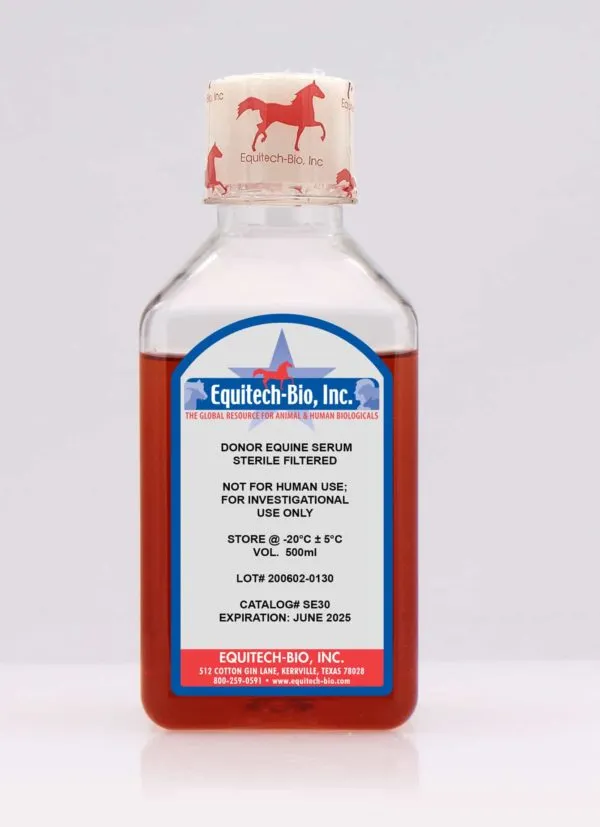
Equitech-Bio supplies horse serum to labs across cell culture, diagnostics, antibody production, and human medicine. It is the liquid fraction of horse blood remaining after clotting and cell removal, and its usefulness depends almost entirely on the source animal’s immune history.
Normal horse serum from non-immunized animals is used for research and blocking applications. Serum from deliberately immunized horses carries high-titer antibodies against specific targets, which is what makes equine-derived antitoxins and antivenoms possible.
What Is Horse Serum?
Horse serum carries albumin, globulins, complement proteins, and growth factors. Antibody concentration varies depending on whether the animal was immunized before collection, a key distinction between the two main types.
Normal Horse Serum
Normal horse serum comes from non-immunized animals with no deliberate antigen exposure. It is used in cell culture as a growth supplement and in immunoassays as a blocking agent or negative control. Its antibody content reflects only natural environmental exposures, not targeted immunization.
Hyperimmune Horse Serum
Hyperimmune horse serum comes from animals deliberately immunized against a specific antigen, toxin, or venom. The resulting serum carries high-titer antibodies against that target. This is the foundation of equine-derived antitoxins and antivenoms used in human medicine.
What Is Horse Serum Used For?
Horse serum serves four primary functions in research and medicine: cell culture supplementation, immunoassay support, antibody-based research, and biologic development.
Cell Culture Support
Horse serum provides proteins, attachment factors, and growth-supporting components for specific mammalian cell types. It is particularly useful in differentiation protocols where the lower mitogenic activity of horse serum, compared to fetal bovine serum, is a functional requirement rather than a compromise.
The C2C12 myoblast differentiation protocol is the most replicated example: researchers switch from 10% FBS to 2% horse serum at confluence to trigger myotube formation by withdrawing proliferative signals.
Immunoassay Blocking
Normal horse serum is a reliable blocking agent in immunohistochemistry and ELISA workflows. When secondary antibodies are raised in horses, pre-incubation with horse serum reduces non-specific binding at tissue or plate surfaces before the primary antibody is applied.
Antibody Research
Horse serum from immunized animals provides a source of high-titer polyclonal antibodies against defined targets. These are used in research applications, diagnostic kit development, and as starting material for affinity purification workflows.
Compared with bovine serum albumin (BSA), which is primarily used as a carrier and blocking protein, equine-derived antibody fractions serve a direct immunological function in these systems.
Biologic Development
Purified equine immunoglobulins are the active ingredient in several licensed therapeutic products. Horses produce large serum volumes relative to smaller animals, and their immune systems generate robust antibody responses after controlled immunization, making them practical production animals for antibody-based biologics.
How Horse Serum Is Used in Cell Culture and Laboratory Research
Horse serum can substitute for fetal bovine serum in specific protocols, but it is not a universal replacement. The decision to use horse serum over FBS depends on three factors: cell type, assay requirements, and protocol history.
Researchers replicating published differentiation protocols that specify horse serum should use horse serum. Switching to FBS without revalidation changes the biology and breaks comparability with the source literature.
For labs sourcing a range of animal serum products, understanding where horse serum fits relative to bovine, canine, and human-derived alternatives is part of experimental design, not just procurement. For species-specific in vitro models, canine serum albumin and similar species-matched materials provide defined inputs that bovine or equine serum cannot replicate.
How Horse Serum Supports Antibody-Based Medicines

Horses have been used to produce therapeutic antibodies for over a century. After controlled immunization, horses generate high-titer antibody responses that can be harvested, purified, and formulated into treatments for human use.
Antitoxins
Equine diphtheria antitoxin was one of the earliest biological therapies used in human medicine, introduced in the 1890s. Horses immunized with diphtheria toxoid produce neutralizing antibodies that, when purified and administered to infected patients, provide immediate passive protection. Tetanus antitoxin followed a similar development path.
Antivenoms
Most snake antivenoms in current clinical use are equine-derived. The production process involves immunizing horses with sub-lethal doses of venom, collecting high-titer serum, and then purifying the immunoglobulin fraction.
Antithymocyte Globulin
Equine antithymocyte globulin (ATG) is a licensed immunosuppressive therapy used in aplastic anemia treatment and organ transplant conditioning. It is produced by immunizing horses with human thymocytes. The resulting polyclonal antibody preparation depletes T-cells and modulates immune activity.
What Role Does Horse Serum Play in Human Vaccinations?
Horse serum is not a routine ingredient in modern human vaccines. That distinction matters because the terms are frequently conflated.
Active Vaccination vs. Passive Immunization
Vaccines train the recipient’s immune system to generate its own protective response. Horse serum-derived products work differently: they deliver ready-made antibodies directly. That is passive immunization, not vaccination. The two achieve similar short-term outcomes through entirely different mechanisms.
Historical Serum Therapy
Before modern vaccines existed, serum therapy using antibody-rich animal blood was the primary tool against diphtheria and tetanus. Patients received equine antitoxin to neutralize toxin already present in the body.
Vaccination replaced serum therapy for prophylactic use, but passive immunization with equine-derived antibodies remains relevant for post-exposure treatment where there is no time for an active immune response to develop.
Vaccine Research Uses
Horse serum and equine-derived proteins can appear in vaccine research workflows as culture supplements, blocking agents, or reference materials. These are manufacturing or laboratory inputs, not formulation components in the finished vaccine product.
Benefits and Limitations of Horse Serum
Horse serum is useful because of its biological complexity, established protocols, antibody content in immune preparations, and availability from specialist suppliers. For passive immunization therapies, it remains irreplaceable in several clinical areas.
Research Limitations
Lot-to-lot variability is the same problem in horse serum as in any biological product. IgG concentrations, complement activity, and protein profiles shift between lots. Qualification testing against a validated reference lot is required before committing to a new supply.
Clinical Safety Concerns
Equine-derived therapeutic products carry a risk of serum sickness, a type III hypersensitivity reaction caused by immune complex deposition.
Modern purification methods and fragmented antibody preparations (Fab or F(ab’)2 fragments) have reduced this risk significantly, but it has not been eliminated. Clinicians administering equine-derived antivenom or antitoxin should monitor for hypersensitivity reactions.
Common Misunderstandings About Horse Serum
Here are some common misconceptions about horse serum.
Serum versus Plasma
Serum is the fluid that remains after the blood clots and the clot is removed. Human blood plasma and its equine equivalent retain clotting factors that serum does not. For most research applications, serum is the relevant product. Plasma is used where coagulation factors or fibrinogen are required.
Serum versus Vaccines
Horse serum delivers existing antibodies. Vaccines generate new ones. Conflating the two misrepresents how both work.
Research versus Treatment
Normal horse serum used in a cell culture lab is not the same material as a clinical antivenom. Collection source, immunization status, processing method, and quality standards differ substantially between research-grade and pharmaceutical-grade equine products.
Conclusion
Horse serum covers a wider range of applications than its niche reputation suggests, from supporting C2C12 differentiation protocols to serving as the active ingredient in licensed antivenom. The key is knowing which type of horse serum you need, sourcing it with full documentation, and validating it for your specific application.
Equitech-Bio supplies normal horse serum and a broader catalog of biological materials for research and development workflows where product quality and traceability are non-negotiable.
Frequently Asked Questions
Let’s clarify some more doubts around horse serum.
Why are horses used to make antivenom?
Horses produce large volumes of serum and generate robust antibody responses after immunization. A single horse can yield several liters of high-titer antiserum per collection cycle, making equine production both practical and scalable for antivenom manufacturing.
What is the difference between horse serum and horse plasma?
Serum is the liquid fraction remaining after blood clots and cells are removed. Plasma is collected before clotting and retains clotting factors, including fibrinogen. Serum is the standard product for cell culture and most research applications. Plasma is used where those additional proteins are functionally required.
Is horse serum the same as fetal bovine serum?
No. Horse serum comes from adult horses and has higher IgG content and lower mitogenic activity than fetal bovine serum. FBS is broadly used for general mammalian cell culture. Horse serum is used in specific differentiation protocols and immunological applications that require lower growth factor activity.