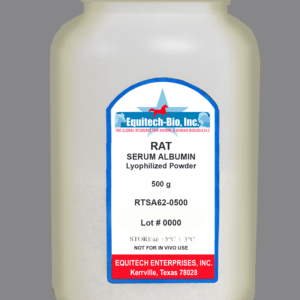
Rat models are the backbone of preclinical drug development, and yet labs routinely run them with albumin that wasn’t sourced to match.
That’s not a minor oversight. That’s a reproducibility problem waiting to happen.
Rat Serum Albumin is the dominant transport protein in rat plasma. It binds fatty acids, regulates oncotic pressure, and shuttles compounds through the circulatory system in ways that are physiologically specific to the species.
When you substitute a bovine or generic albumin into a rat-model system, you’re not saving time. You’re introducing a variable you’ll spend weeks trying to locate when your data doesn’t hold.
Albumin from rat sources, supplied as lyophilized powder, reconstitutes cleanly in ultrapure water and resolves sharply with Coomassie blue staining for verification. It’s characterized, consistent, and built for research use in systems where the species origin of your proteins actually matters.
The question isn’t whether you need rat albumin. If you’re running rat models, you do.
Rat Albumin is used in immunoassay development, diagnostic procedures, and as a species-matched blocking agent to reduce cross-reactivity noise introduced by bovine proteins. It’s also a reference protein in pharmacokinetic and drug development studies. Labs running rat plasma-based protocols use it to prepare and validate binding conditions before scaling. Research use only.
BSA is convenient, not universal. Albumin from rats has a distinct amino acid sequence, different fatty acid-binding kinetics, and a plasma protein profile that diverges meaningfully from that of bovine sources. In sensitive diagnostic procedures or drug development assays, that divergence shows up in your results whether you account for it or not.
Rat models dominate preclinical research, and human serum albumin translation studies often trace back through rat data first. Using rat albumin that matches your model’s plasma proteins removes one more uncontrolled variable from a system that already has plenty. When you need to decrease the quantity of ambiguity in your results, you start by matching your reagents to your model.
Yes, species specificity is important in your culture conditions. Labs that increase the physiological relevance of their in vitro work use rat albumin to better approximate the protein environment from which rat-derived cells actually come. Pair it with a validated goat anti-rat secondary antibody for downstream detection, and you’ve built a system where every component earns its place on the bench.
 English
 Arabic

 English
 Arabic