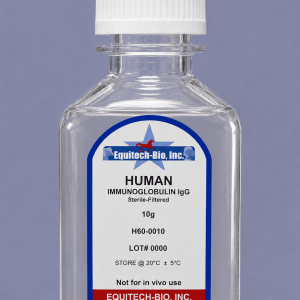

Human immunoglobulin G is the most abundant class among serum immunoglobulins in human serum, accounting for the majority of circulating antibody activity in the healthy adult immune system. It is structured around four peptide chains, two heavy and two light chains, linked by disulfide bonds into a molecule whose IgG function spans pathogen neutralization, complement activation, and Fc-receptor-mediated immune response coordination.
IgG subclasses, IgG1 through IgG4, differ in Fc fragment structure and effector functions, which is why subclass-specific reference standards matter in research where the functional distinction between subclasses is the experimental variable. Pooled normal human serum provides a polyclonal human IgG reference that reflects the natural distribution of subclass concentrations in the healthy donor population. Normal human serum derived from multiple donors reduces the lot-to-lot variability introduced by single-donor preparations into calibration workflows.
Equine IgG and human immunoglobulin serve parallel reference roles in their respective species, but the structural differences between equine and human IgG subclasses mean cross-species substitution is not appropriate in human model assays. Protein concentration is documented per lot for quantification accuracy.
For rabbit-derived isotype control pairings in the same panel, normal rabbit IgG and IgG bovine reference standards extend cross-species immunoglobulin coverage. Research use only.
 English
 Arabic

 English
 Arabic